The missing last frame
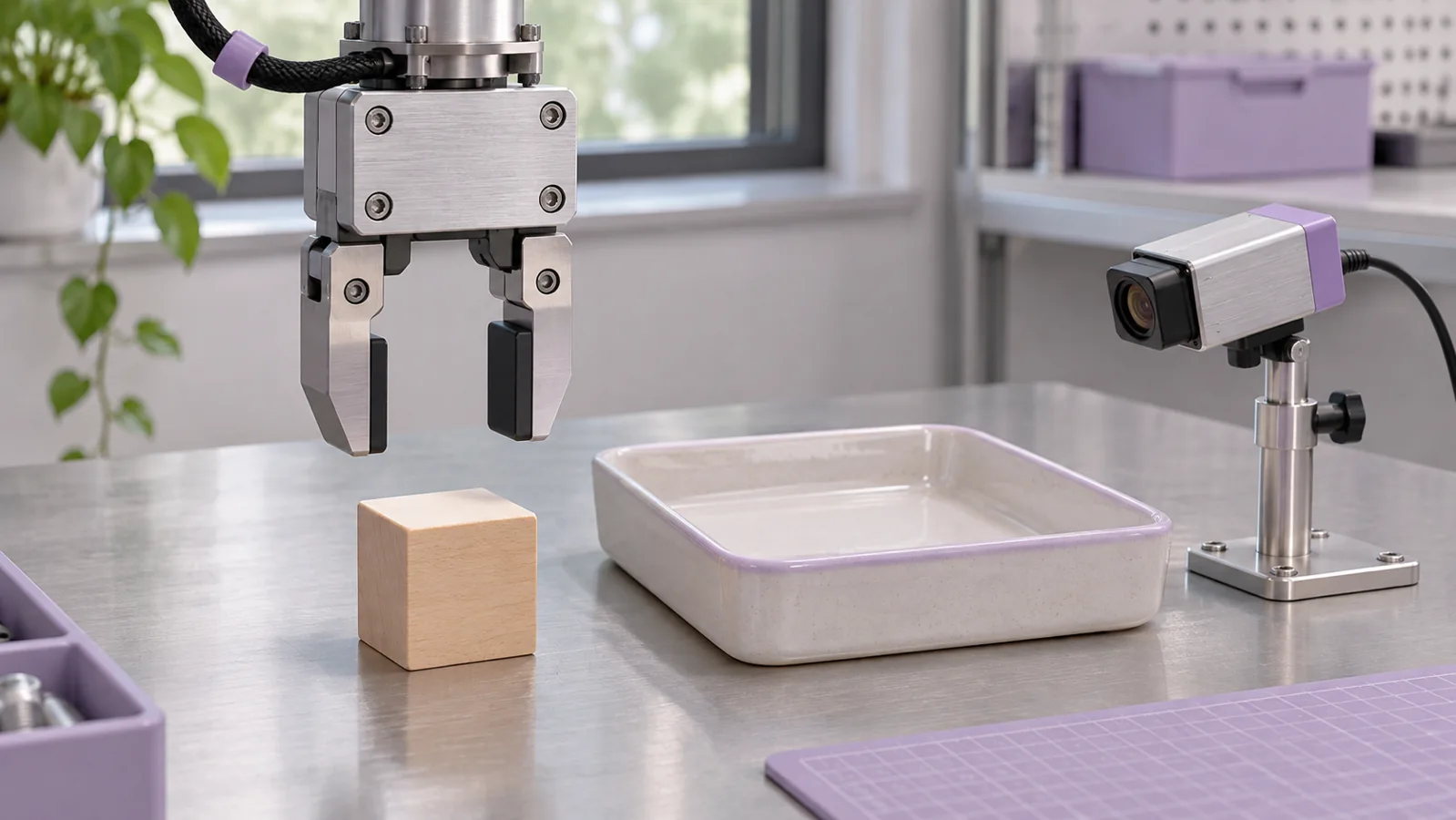
Imagine a robot moving a block into a tray. The arm reaches the correct position, its gripper opens, and the video ends. Did the task succeed? Perhaps the block bounced out. Perhaps another block was already there. Perhaps the camera cannot see the tray floor. A convincing movement and a completed job are different things, and a useful system has to connect them.
An October 30 community research overview from Projectsim examines the engineering between a generalist robot policy and a dependable deployment. It discusses planning, memory, outcome checks and adaptation. Its useful contribution is the reminder that carrying learned skills into a new setting still leaves integration work. This is a research synthesis, not a new robot anyone can install without preparation.
One cited paper, VoLo, studies a system combining a vision-language planner and monitor with a manipulation policy and supporting tools. Its evaluation provides evidence about that particular configuration, not a guarantee for another arm or room. We have not reproduced its experiments. The method below is our proposed way to turn this line of research into a clearer beginner project: define an outcome contract before asking a machine to achieve it.
Source: Projectsim: How do we get to plug-and-play robots? ↗ · VoLo: A Physical Orchestrator for Open-Vocabulary Long-Horizon Manipulation ↗
Start with a scene description that could be wrong
An outcome contract is a small, explicit description of the world you expect to observe after an action. For the block task, it might say that the blue block is fully inside the tray, the gripper is no longer touching it, and the arm has returned to a designated resting area. Those conditions are proposed design requirements, not features promised by a particular model.
The phrase fully inside matters. If your contract only asks whether the block and tray appear in the same image, a scene with the block beside the tray could pass. If it only asks whether the gripper opened, an empty grasp could pass. Writing the condition makes it possible to disagree with the monitor before a real motor moves.
Choose a coordinate frame for your description. Left of the tray could mean left in the image or left on the table. A camera placed across the bench can reverse those interpretations. For a first exercise, use relations that remain clear in the intended view: resting on the tray floor, outside the marked border, or separated from the gripper by visible space.
Also specify what the system is allowed to conclude when the evidence is incomplete. A hidden tray floor should lead to an unknown result. It should not quietly become a success because the action looked normal. Unknown is a useful operational state when it asks for another observation or a person, rather than triggering an endless retry.
Build the test without a robot first
You can explore most of this problem with paper, a phone camera and household objects. Put an empty cup beside a small box and sketch the desired final arrangement. Then photograph several deliberately different outcomes. This does not evaluate a robot policy. It evaluates whether your definition and observation method distinguish the situations you care about.
Include an obviously successful scene, an obvious miss and a scene where the answer is hidden. Add a misleading success: the object is visible over the container but held in place by a support outside the frame. The point is to discover whether your rule depends on appearance alone when you actually care about physical containment.
Ask a second person to classify the pictures using only your written contract. If they reasonably disagree with your answer key, improve the contract. An AI monitor cannot resolve an ambiguity that you have not decided how to handle. This exercise can save you from confusing a vocabulary problem with a perception problem.
Keep the pictures you used to revise the contract separate from a small final set you have not inspected during tuning. For example, a friend could prepare the final arrangements after the wording is frozen. Treat that as a modest practice evaluation, not evidence of general reliability. A few tabletop pictures do not establish performance under changing lighting, moving cameras or unexpected objects.
Track the job as a sequence of evidence
A practical task record could have four stages: ready, action requested, result observed and result accepted. The labels are our suggested bookkeeping scheme. Their purpose is to avoid treating an instruction sent to the controller as proof that the physical world changed.
In the ready stage, record the starting arrangement and whether the workspace meets your intended conditions. In action requested, save the bounded action you intended. In result observed, collect a fresh view after movement has stopped. In result accepted, apply the finish condition to that view. A failed stage should remain visible in the record.
This makes a common ambiguity easier to diagnose. Suppose the result is wrong. Did the planner choose the wrong destination, did the controller fail to execute the chosen move, or did the observer incorrectly accept the scene? Without the intermediate record, the whole incident can become one vague statement that the AI failed.
Avoid asking the same generative response to both invent a plan and certify its own success without independent evidence. That arrangement might still work in some circumstances, but it makes disagreement difficult to locate. A separate observation, a simple geometric check or a human review gives you another place to challenge the conclusion. The appropriate check depends on the task and equipment.
A reset belongs in the experiment
A neat demo often begins from a tidy scene. A real practice session includes spilled objects, interrupted runs and attempts that leave the workspace in an awkward position. Plan how the next trial begins. Otherwise, a recovery that required a person can disappear from the reported success rate.
For a paper exercise, a reset might simply mean returning the cup and box to their marked positions. For any physical robot, follow its exact manufacturer's assembly, power and operating instructions. Keep the work area clear, use suitable supervision and stop when motion is unexpected. This article is not a commissioning procedure or permission for unattended movement.
Write down every human intervention. Count a nudge to the tray, a camera adjustment and a manual completion decision. The resulting number is not embarrassing. It tells you which part of the system still depends on someone being nearby. A project that succeeds reliably with one planned reset can be more useful than a supposedly autonomous project that needs unpredictable rescue.
Treat hardware documentation as part of the reset plan. Similar-looking arm kits can use different controllers, power arrangements and software. Match the exact model and revision before following an example. A tutorial for a newer similarly named kit is not enough evidence that an older kit supports the same operation. You can complete the observation exercise without buying hardware, then decide whether a physical build adds a useful question that the paper exercise cannot answer.
Count several kinds of failure
For your first log, use plain-language categories rather than a single grand score. Record whether the job physically finished, whether the monitor said it finished, and whether a person had to intervene. These are three different questions. A monitor that always says no may avoid false celebrations while making the system unusable.
Consider a hypothetical set of twelve paper scenes. Nine are clearly classifiable, two hide the relevant relationship and one exposes an ambiguity in the contract. Do not turn this invented example into a model benchmark. Its purpose is to show why excluding the hard scenes after seeing them would make your evaluation look cleaner while reducing what it teaches.
A mistaken success deserves special attention because it can move the workflow forward under a false assumption. A mistaken failure can waste time through unnecessary retries. Which matters more depends on the project. Sorting craft blocks and handling fragile equipment do not have the same consequences. Set the acceptable behavior before reviewing the results.
Report the denominator. If you ran fifteen trials but only show the ten where the camera had a clear view, say so. Better still, keep camera-visibility failures as a separate result. A useful system includes its observation setup, so an inability to see the job is an operational limitation rather than an inconvenient detail outside the evaluation.
Change the difficulty and preserve the evidence
Once the simplest scene works, vary a condition that has a clear reason to matter. Move the tray slightly. Change the background. Rotate the object. Partly obscure the destination. Keep other conditions as stable as your setup allows so that a changed result gives you a useful next question.
A progression might begin with a single object and fixed camera, then introduce a second similar object. That second object tests identity: did the system follow the intended block or accept any block in the tray? Another progression changes the viewpoint while preserving the same physical arrangement, testing how much your check depends on one lucky angle.
Do not describe this as proving robustness. It is a way to find particular weaknesses. The claim should stay close to the exercise: the contract distinguished these arrangements in these views. A larger deployment needs more representative testing, appropriate engineering controls and evidence for the actual environment.
If you alter the contract after a failure, record the version and rerun a fresh set. Otherwise, old scores and new rules become mixed together. Keeping a short version history lets you tell whether an apparent improvement came from better perception, easier criteria or quietly removing the cases that were troublesome.
The most reusable output from a small robotics project may be a concise task sheet: the starting conditions, permitted action range, finish condition, observation method, stop condition and reset procedure. Someone else should be able to read it and understand exactly what the video claims.
Add a short account of the failures. Show one scene that fooled the monitor and one that correctly produced uncertainty. These examples reveal more about the boundaries of the system than a montage containing only smooth movements. They also give a future collaborator a concrete starting point for improvement.
The broader research direction is promising because planning and verification can become explicit parts of the system. That does not remove the need to validate them. Our interpretation is that plug-and-play robotics will be easier to assess when the reusable unit includes an outcome check and a recovery plan alongside the learned policy.
For now, make the ending of your demo boringly clear. Show the final arrangement after the arm has stopped. Explain the evidence that supports success. Keep uncertainty visible. A project that can tell you precisely when it has finished is a stronger foundation for the next task than one that merely knows how to keep moving.
Try this, then make it yours.
Use a paper tabletop scene to specify one pick-and-place task. Write what must be visible at completion, then design three pictures that should prevent a success report.
Follow the signal.
Our reporting starts here. Practical suggestions are our analysis, and vendor performance statements are claims unless independently verified. We haven’t hands-on tested this release.
- Projectsim: How do we get to plug-and-play robots? ↗ · 2026-10-30
- VoLo: A Physical Orchestrator for Open-Vocabulary Long-Horizon Manipulation ↗